Kamis, 11 Desember 2014
And I'm Back...
Philosophies aside, nine months later and I'm back into Bitcoin. I am a trader after all, am I not?

Anyone Still Around from 2011?
I can't believe I started blogging about Bitcoin over three years ago! Are any of my original readers still out there? Who knew we'd go from a market cap of under $50 million to over $5 billion! Crazy!
Anyway, please share your stories in the comments below.
Anyway, please share your stories in the comments below.
Selasa, 09 Desember 2014
Testing 1, 2, 3...
Hello, hello. Testing 1, 2, 3. Is anyone still out there? Still awaiting the Bitcoin Renaissance... I think it's coming but not just yet.
Rabu, 17 September 2014
Marketing Guru? Earn BTC With the LocalBitcoins Affiliate Program!
We just improved LocalBitcoins Affiliate Program a little bit. Now you can get a CSV, which includes information about your converted users. Also a short list of your latest converted visits are included on the affiliate page. Using this info, you can improve your targeting.
Next we plan to implement a tracking pixel for the affiliate program. If you have ideas or feedback related to the affiliate program, comment below!
Next we plan to implement a tracking pixel for the affiliate program. If you have ideas or feedback related to the affiliate program, comment below!
Senin, 08 September 2014
Accept bitcoin - send invoices, get paid in bitcoin
You can now use LocalBitcoins to accept bitcoins and send bitcoin invoices to your customers. LocalBitcoins has opened Merchant tools section on the site where you can send and manage invoices.

The invoiced amount to pay can be denominated in any currency. When the recipient opens the invoice, the price is converted to bitcoins using the current exchange rate.
Each invoice has a unique bitcoin address as the payment reference. The payment can be made with any bitcoin wallet, including QR code compatible mobile wallets.

The invoiced amount to pay can be denominated in any currency. When the recipient opens the invoice, the price is converted to bitcoins using the current exchange rate.
Each invoice has a unique bitcoin address as the payment reference. The payment can be made with any bitcoin wallet, including QR code compatible mobile wallets.
Selasa, 02 September 2014
Easier reporting of suspicious user activity
LocalBitcoins site has now a new user reporting feature. You can find the user reporting link from the public user profile page. The new feature makes it easier to report suspicious users, though this option has been always available through the support ticket system.

LocalBitcoins support team checks the reported users and may take necessary action to suspend the user account if there is evidence of breaking the site rules and good trade etiquette. Potential reasons to report a user may include
- Fraudulent activity
- Violating LocalBitcoins terms of service
- Misleading information
- Abuse
Senin, 25 Agustus 2014
Buying and Selling Steam, Amazon, Apple etc Gift Cards on LocalBitcoins.com
Gift cards are a nice way to buy stuff froom your favourite store, which doesn't accept bitcoin yet. There has been some gift card trading on LocalBitcoins, but now we have added couple of new features which should make gift card trading much easier.
Questions, comments, suggestions? Happy trading!
 |
| Contacters can select the amount with dropdown. |
 |
| Several Gift Card types have been added, you can also select the generic option and name your own. |
 |
| Type the nominations as comma-separated list. |
 |
| Remember to add "Track liquidity" to remove your sellable amount automatically as orders roll in. |
Questions, comments, suggestions? Happy trading!
Selasa, 12 Agustus 2014
Much soul, very emotion: Why I buy into the cult of Dogecoin

Please note: This piece was originally commissioned by the magazine MCD, and will be appearing in French in their December edition.
I use Dogecoin because I’m emotionally drawn to the dog. Unlike the distant, fossil-like Queen on the Pound banknote, the Shibu Inu is at once transcendent and approachable, self-contained but cuddly, looking into my eyes with a sideways glance, as if it just noticed me and is wondering whether I want to play or be left alone. It’s not an aggressive dog, or for that matter, a bouncy dog trying to lick me. It has self-directed, quirky soul, and it’s almost impossible to imagine this dog being an asshole.
Some people in the crypto-currency community have written Dogecoin off as a joke, or even a scam. Maybe it’s both, but does this matter? All currency in the final analysis is really a scam, and the real question is which of those scams we want to agree to. I for one would rather pledge allegiance to a mystical pooch than to worship the image of a redundant monarch.
Indeed, Dogecoin, to me, is the best of all of the so-called ‘alt-coins’, the alternative crypto-currencies that have emerged as offshoots from the original Bitcoin source-code. Here is why.
Money isn’t ‘rational’
Run this question through your brain: Why did people invent pottery?
The response from many people is ‘because it must have been useful to store food and water’, an answer which chimes well with our prevailing rationalistic world view. Nevertheless, not only is the assumption that pottery was explicitly ‘invented’ problematic, but evidence suggests that it was originally used to create abstract religious figurines. The details of such archaeological debates don't matter here - what matters is to realise that we often have an automatic bias towards thinking about history in terms of what we're used to in the present.
 |
| ANCIENT POTTERY: TOTALLY FUNCTIONAL |
Why do I bring this up? I do so because there is a similar problem among many economists who attempt to peddle ahistorical narratives about ‘why people invented money’. Their story normally involves people ‘rationally’ designing money as an alternative to ‘barter’. There is very little immediately rational about exchanging real goods for pieces of paper or shiny bits of metal though. Sure, once the social convention of monetary exchange is set up, it’s useful, but the imagined process in which bakers and butchers ‘invent’ money to deal with the awkwardness of exchanging meat for sourdough loaves is an attempt to reverse-engineer history from the perspective of present dogma.
Money is not an object that can be invented. It is a social convention that has to be culturally constructed. The use of monetary tokens only appears rational once we’re party to a collective agreement (or delusion) to imbue those tokens with value, and that collective agreement needs to be constantly maintained.
State power, local trust, meta-national mysticism and labour

In the case of our normal fiat currency, the collective agreement is given strength by the psychological (and real) force of official authorities. Most of our fiat currency is created by commercial banks, but derives much of its ‘reality’ from state endorsement of its legal status.
In the absence of a state championing a currency, you need other factors to induce collective acceptance. For example, a very small community might be able to create and maintain a local currency backed by nothing but the preexisting communal trust network, woven together from mutual friendships, ties of honour and anxiety at facing exclusion from the social group.
To create belief in a non-national currency that is not located in a small community though, is especially hard. Bitcoin provides a fascinating case study of the process. When it first started, Bitcoin commanded almost no value. It had one crucial feature though. At its heart was a mysterious, almost immaterial figure called Satoshi Nakomoto, a focal point for a community to rally around.
The mystique of Satoshi was vital, imbuing what was otherwise a clever but cold piece of cryptography with a soul that people could believe in. Satoshi was the holy ghost in the machine, and the act of mining resembled a ritualistic quest to build on the blockchain started by the ghost. It’s through this process that the imagined value of Bitcoin came to life, and started taking on a reality.
By contrast, imagine if a well-known person, like Stephen Hawking, invented Bitcoin. It would be devoid of all mystery, resembling a science project or a corporate product, rather than an underground movement. The specifics of Stephen’s personality would replace the cryptic symbol that the Satoshi figure once stood for, and what would you have left? A clever piece of cryptography, and a somewhat banal act of using up energy in running computers.
That said, there is something about the pointless nature of randomly churning algorithms through a computer that is psychologically powerful. If you want to imagine that something essentially ephemeral is a useful commodity, it helps if you expend labour in creating it, because labour implies scarcity (you only need to work for things that are scarce), and scarcity implies a potential for an exchange value (if something is abundant there is no need to exchange anything for it).
The computing power (‘labour’) put into the Bitcoin network does not create value in itself, but is a further psychological backer to Bitcoin tokens’ imagined value. If they weren’t valuable we wouldn’t exert all this labour would we, and because we exert this labour they must be valuable, right?
The emergent myth of Bitcoin’s rationality
 |
| 'WE WOULDN'T BUILD IT IF IT WASN'T VALUABLE... RIGHT?' |
Interestingly, as the ritualistic process of mining has become increasingly competitive, and the commercialisation of Bitcoin has steamed ahead, new narratives have formed to explain why Bitcoin tokens ‘rationally’ have value.
Chief among these is the idea, touted by the Bitcoin foundation itself, that bitcoins have value ‘because they are useful’. It is part of a broader trend among the Bitcoin elite to rewrite history and claim, in hindsight, that the value of Bitcoin was always self-apparent, and that early adopters were just getting involved due to rational future expectations of increasing societal recognition of Bitcoin’s use value as a secure means of exchange.
In this formulation, Bitcoin tokens derive their value by being part of a potentially useful system, the value of each bitcoin reflecting the aggregate market assessment of how useful it is to have a secure means of exchange. It’s kind of like arguing that containers on train carriages derive the entirety of their value from the usefulness of the rail network. The implicit narrative is this: Hey, these things are useful as transmitters of value for exchange, so let’s compete over them, and in so doing create their market value, which can now be used for exchange.
Circular no? There may be a glimmer of truth in it, but it’s mostly an attempt to describe the essentially emotional and social process of currency creation with the language of cold individual rationality.
Tin-man currencies ain’t got no heart
This thinking has subsequently influenced the way that a lot of alternative crypto-coins have attempted to market themselves. Rather than embracing their own absurdity, many alt-coins have marketed their efficiency, their security, or their application to some specialist use case, as if the usefulness and competitiveness of the design was the most important aspect of why a person accepts a currency.

The crypto-conference has thus become the realm of ‘serious people’ discussing ‘serious business’, not wishy-washing mysticism and emotion. They appeal to rational functionality, rather than inspiringpeople to use them. They are techno-fetishistic. A guy with a PowerPoint presentation calmly explains the business case for why his crypto-currency is valuable because it uses a state-of-the-art turbo hashing system, but for fuck’s sake, tell me why I should BELIEVE in it!
It’s true that this strategy has worked to some extent for some alt-coins like Lightcoin, Quarkcoin and Peercoin, which have gained some popularity based on design, but think about this question: Why do you use British Pounds or Yen? The answer to that is never, ‘because they’re well designed’, and neither is it ‘because I rationally see how useful it is for me to have a medium of exchange’, and neither is it ‘because I’m intimidated by the state and they force me to use it’.
Our answer is mostly just ‘because everyone else seems to use it and I was taught to use it’. We are born into currencies just like we are born into languages, and we learn to use them in a social context. If you want to convince a person to accept ephemeral electronic records as a currency, you need a story for people to hold on to. You need heart.
Dogecoin is a cult, and that’s how it should be

Which brings us to Dogecoin. I can believe in Dogecoin because it gives me something to believe in. It’s a direct appeal to irrationality, a direct appeal to transcend the banal world of individual utility calculation and submit to something hilariously absurd. It is, above all, a cult, and that is infinitely more attractive than any cold appeal to robust design.
It is the peaceful, playful gaze of the Doge itself that is the mystical foundation of the currency. It doesn’t matter who invented it, because Dogecoin is not experienced as a narcissistic project of a particular person, and it’s the symbol itself that is the leader. The Doge is a figure without ego, with cross-cultural, cross-gender, and yes, even cross-species appeal. We can all get something from the gaze of the Shibu.
This is reflected in the resultant community that has emerged around Dogecoin, people who refer to themselves as ‘shibes’ and give each other gifts of Doge. While the Bitcoin subreddit has turned into a moshpit of aggressive trolling, Dogecoin forums feel inclusive and accepting, cohering around a surreal world of esoteric slogans and acts of goodwill.

In closing then, a word on design. If there has ever been any clever design in Dogecoin, it’s been in the way the core members have focused on creating a culture from the bottom-up, rather than fetishising currency creation as a technical solution to be marketed from above. The Dogecoin community has grown rapidly in response to community acts that establish a reason to believe in the currency, such as the sponsorship of underdogs like the Jamaican bobsleigh team, and oddball stunts like backing a Nascar racer.
These are things you can sit in a pub and laugh about, outside conference halls, and that makes all the difference.
Some things to do if you enjoyed this article...
I sometimes spend weeks writing these articles, and don't generally get paid to do it, so if you enjoyed please consider doing one or two of the following
- Doge donation: 4 donashuns plz send luv to DMiqDUR1hzMRFiKRUVuqGqwP7bh2HzVMuZ
- Support by buying me a virtual beer
- Tweet: You can tweet it out!
- Share it on your Facebook wall here
- Email it to one friend from here
- Leave a comment!
- Submit to Reddit
- Link to the article from your own blog so your readers can see it too
Minggu, 10 Agustus 2014
LocalBitcoins ATM:s comes out of the oven and goes on the tour
It has been a long time since there have been any news regarding our ATM project which aims to provide automatization for converting cash to bitcoins and vice versa. Another perks of the Localbitcoins ATM:s are the moderate price and the fact that the device works completely offline. ATM:s are integrated to Localbitcoins website, and the actual bitcoin trade happens on Localbitcoins.com; the ATM only takes care about the fiat handling.
Eventually you will be able to purchase these ATM:s directly from Localbitcoins website. The price of the ATM's is 1500 eur + VAT and shipping costs.

There have been two beta versions of these ATM:s in real life testing at the center of Helsinki, Finland. One of them is in a bitcoin accepting restaurant and another one in 24h kiosk. So far there haven't been any major problems, and minor ones have been carved out during the testing process. If you are visiting Helsinki, you can find those ATM:s from here, and here.
Expect to see more of these ATM:s soon, since we are getting our first production batch out soon, and we are putting one of them on the bitcoin tour, held by Finnish bitcoin company Bittiraha.fi. They will be driving around Finnish archipelago and testing how well Localbitcoins bitcoin ATM performs on the road.
Eventually you will be able to purchase these ATM:s directly from Localbitcoins website. The price of the ATM's is 1500 eur + VAT and shipping costs.
Specifications of the ATM
Buying process: Buyer feeds banknotes to the machine, and gets a secret code in return. The code is used to claim the corresponding amount of bitcoins to your localbitcoins.com account. The exchange rate is defined at the moment the code is used.
Selling process: Seller logs in to his/her localbitcoins account, and goes to the URL of the ATM he/she aims to use for withdrawal. The seller selects the amount he/she wants to withdraw from a dropdown menu. After selecting the withdrawal amount, corresponding amount of bitcoins are reduced from the seller's localbitcoins wallet and the user will receive a code, which is given to the ATM through the keyboard. After the code has been inserted, the ATM will give corresponding amount of notes to the customer.
Capacity: Capacity: note recycling unit can hold 30 bills and cash box 300 bills.
Accepted bills: All banknotes where the size is inside of the range (width) 60-82 millimeters, and (length) 115-150 millimeters. The device can accept 6 different kind of bills from the selected currency. The device can be programmed to handle almost any known currency, but only one can be used at the time.
Size(w/h/d): 318 x 340 x 264 millimeters
Display: 87.3 x 41.8 mm one color lcd display
Weight: 15 kg
Selasa, 05 Agustus 2014
Bitcoin Payment Debuted on Physical Stores in Shenzhen, China


Since August of this year, stores accepting bitcoin payment have been emerging in Kexing Science & Technology Park, Shenzhen, where is full of Internet companies. These stores are mainly restaurant. In China, the central bank stated that bitcoin is not currency, but admitted that trading with bitcoin is legal. Although China is one of the biggest markets for bitcoin trade, its bitcoin payment market is still on infancy stage.
Stores: Currently bitcoin payment volume is still small
On the Yuanwei street of Kexing Science & Technology Park, several restaurants have accepted bitcoin as payment. Since the business is just started, cashiers are not familiar with the payment process yet. For example, 'Accept Bitcoin' label has been put on the front door of Cafe de Flore. However, when customers ask if they can pay with bitcoin, cashiers are still muddle-headed. They need time to skilfully process bitcoin payment.
As to Maggies's Club, another bar on the same street, the cashier clearly expressed that they accept bitcoin payment, but customers need download a third bitcoin payment platform, 'Btct' App. Customers transfer bitcoin to their Btct account to finish payment, which is like Paypal in Bitcoin world.
The CEO said she likes the convenience of third payment platform, which has no big difference from Group-Buying platform. Launching bitcoin payment for her bar is icing on the cake, and at least can attract btcer to expand customer pool, even though currently the volume is still very small.
Payment Platform: Still on user development stage
In December of last year, the statement of Central Bank of China has emphasised that bitcoin is not real currency, and forbidden financial institutions and payment institutions to price products or services with bitcoin, but admitted the legitimacy of trading bitcoin, which made bitcoin purely an investment product in China. After experiencing ups and downs, bitcoin price is stabilising between 3589.00 ~ 3634.92 CNY. Bitcoin payment in physical store is still rare. Some bitcoin insider claimed that currently the number of physical stores accepting bitcoin in China is less than 30.
As a third payment platform for promoting bitcoin, the main purpose of Btct is to change the atmosphere of bitcoin speculation in China to the original nature of bitcoin as a payment method. One of the co-founders of Btct said although the number of physical stores accepting bitcoin is still small, Shenzen where has strong Internet cogitation has advantages to promote bitcoin payment. Moreover, Btct provides CNY exchange, which shares the risk of bitcoin fluctuation.
Source: http://news.ifeng.com/a/20140805/41442467_0.shtml
Pictures: http://www.btcside.com/new/detail/1670
Rabu, 30 Juli 2014
HMAC authentication option recommended for API users
It is now possible to access the LocalBitcoins API using HMAC authentication instead of OAuth 2. This new authentication method is more suitable and secure for your own scripts and non-distributed applications. We suggest to use it whenever possible.
API tokens will now also reset on account security changes. If you change your password or if you enable login guard or two-factor authentication, the API access credentials are reseted. This means deleting all API clients, tokens, and authentications.
In the future, console authorization of OAuth 2 will be disabled and all who use API for scripting access are recommended to migrate to HMAC authentication.
Please see the API documentation for instructions how to update your scripts and API clients.
API tokens will now also reset on account security changes. If you change your password or if you enable login guard or two-factor authentication, the API access credentials are reseted. This means deleting all API clients, tokens, and authentications.
In the future, console authorization of OAuth 2 will be disabled and all who use API for scripting access are recommended to migrate to HMAC authentication.
Please see the API documentation for instructions how to update your scripts and API clients.
Kamis, 17 Juli 2014
Breaching the monetary Matrix: Five exercises to help you understand money

(Note: I originally wrote this article for the July 2014 edition of Contributoria, and it is republished here under the following Creative Commons licence. If you wish to use the article, please attribute the original)
"Like everyone else you were born into bondage, born into a prison that you cannot smell or taste or touch, a prison for your mind."
This is a line from The Matrix. Morpheus is explaining to Neo that he’s actually stuck in a nightmare prison-world enslaved to computers. The world is not as you think Neo, but I can set you free, provided you take the red pill.
In some ways Morpheus resembles one of those single-agenda zealots who goes around telling people that they have a certain secret truth that will liberate them, like the guy who corners you in a pub and says, “Don’t you realise we’re trapped in a corporate prison. The Bilderberg Group owns the world’s governments!”
Morpheus, however, is also different to the average conspiracy theorist. The key dynamic in The Matrix is that the power structure he’s trying to reveal is invisible in all ways, an immersive totality that transcends the world of identifiable ‘things’. He spins no tales of illuminati hiding in Goldman Sachs, or secret meetings between elites in Swiss cantons.
The problem with the average conspiracy theorist is that their targets – such as corporations – are too obvious. Corporations may be giant, semi-immortal entities that vaguely resemble autonomous hive-minds bent on cultural hegemony, but they often do it bluntly, pushing cheesy propaganda and brandishing gadgets at us, lobbying politicians, and so on. In the end, there are ways for people to exert influence over them, and they occasionally disintegrate. Corporate power is subtle, but not that subtle.

If anything in the world actually resembles Morpheus’ conspiracy, I’d say it is money itself. Money is extremely subtle. We think of the monetary system like we think of air, or language – as something that surrounds us and that we take for granted. We are born into a monetary system we cannot smell, or taste, or touch, so obviously normal as to be virtually invisible.
Indeed, when we’re asked to describe money, we often give fuzzy, imprecise descriptions, despite the fact that we may use it every day. Even those who work in the financial sector, and who spend all their time designing financial instruments like bonds to steer money from one place to another, frequently cannot tell you precisely what money is. Take, for example, the anti-hero of The Wolf of Wall Street, a hotshot broker immersed in money, but who literally has no idea of what it is, and what’s more, is controlled by it like a puppet.
I find money intensely mysterious, and there are no Matrix-style red pills that can be taken to help one deconstruct it. In August 2013 I published a piece called Riches Beyond Belief in Aeon Magazine, exploring the cultural dynamics of currency. Following that, it occurred to me that it would be useful to develop some more practical exercises and thought experiments to try stimulate thought about particular aspects of the monetary mystery. This article introduces five of those exercises, and I hope that collectively they may help you develop your own ideas. I’ve set them out in a particular order, but you can jump to those that interest you most.
Exercise No. 1: The web of value

This first exercise is a warm up, aimed at situating money relative to other goods. Look around you and try locate a few objects in your immediate vicinity. Perhaps you’re sitting at a desk, and there is a decent Casio scientific calculator, a Parker ballpoint pen, a bottle of Jack Daniels, and an A4 note pad. You’ll also need to have one foreign bank note, and one local bank note.
The challenge, part 1
Pick two of the objects, for example, the calculator and the Parker pen. Your task is to work out a rough exchange ratio between them. How many pens is the calculator worth?
You don’t have to work out an exact ratio, but aim to create a band of likely exchange ratios, testing the outer bounds of plausibility. The calculator is not likely to be worth 10 000 pens, for example, but it’s probably likely to be worth more than 1 pen. Perhaps you say the calculator is roughly worth 4-7 pens, depending on the situation and their relative quality.
You’ll note that you have an intuitive, almost subconscious ability to assess one object relative to another, even if it’s only in very rough terms. What precisely is it about the objects that allows you to make the comparison? Perhaps it’s their perceived utility (‘the calculator can undertake more complex actions that the pen, and it lasts longer’), or perhaps it's the imagined difficulty in creating the objects ourselves (‘the calculator seems to have more complex technology built into it, and is harder to make, requiring more physical or intellectual labour’). Perhaps it’s just due to some learned perception of the value (‘Parker is a good ballpoint brand isn’t it?’), or some combination of those factors.
Now that you’ve established one exchange ratio, add another. How many note pads is your bottle of Jack Daniels worth? You will find that these exchange ratios fluctuate even with yourself, depending on what time of day it is and your mood or situation. That won’t stop you being able to make a rough band though: ‘It’s unlikely that I’ll ever exchange a bottle of Jack Daniels for just one note pad, surely it’s worth at least three, but I’d never exchange 200 note pads for a bottle.’
Now create a third exchange ratio, perhaps between the ballpoint pen and the notepad. In doing this, you’re building up a rough network of exchange values, and theoretically there should be some coherence between your perceptions. If roughly 4 good quality pens are exchangeable for a decent calculator, and roughly 3 standard notepads are exchangeable for a good quality pen, it is implied that roughly 12 standard notepads are equal to the calculator. Does that seem plausible to you, or do your perceptions of value have some inconsistencies?
(As a side note, you’ll probably find that your perception of value gets warped by scale, leading to certain inconsistencies. The perceived utility of any object tends to diminish with increased scale, a phenomenon economists call ‘diminishing marginal utility’. For example, you may be able to conceptualise the usefulness that three pens have to you, but it’s probably difficult to conceptualise the usefulness of say, 3000 pens)
The challenge, part 2
Let’s now assume you’ve developed a loose latticework, something like a spider’s web, of these object pairs and the exchange ratios between them. Now take a foreign bank note, a currency that you’re not used to using, and try to integrate it into the network. How many pens would you exchange for 50 Turkish Lira?
Notice something strange? We have some internal intuitive sense that guides us when making a rough comparison between two objects, but there is nothing about a foreign bank note that allows us to make a similar comparison. The truth is that you probably have no idea about how much a Turkish Lira is worth, unless you are from Turkey.
This is something that tourists frequently experience, holding a strange foreign currency in their hands, having little idea of what it should be exchangeable for. What actually happens when you are a tourist? You learn what the currency is worth by observing others and by experience. You slowly calibrate your sense of its worth by seeing examples of goods priced in it.
Now, by way of contrast, take a currency you’re familiar with, perhaps the British Pound, and integrate it into the network. You’ll find that you already have a set of pre-established ideas about the exchange ratios between British Pounds and the various goods. Oh, Jack Daniels is worth about £15 isn’t it? A good quality ballpoint pen is worth maybe £8. An A4 notepad is probably around £3. A scientific calculator is maybe £30-40. Take a look at the ratios between these prices. Do they correspond to the ratios you established in the first part of the challenge?
Discussion
The point of this is to highlight that the value of modern currency cannot be thought of independently of the economy and people it is connected to. There is nothing about a British Pound in itself that can tell you how many pens it is worth, but once it is installed at the centre of a giant interconnected social network of goods and services, its value gets locked in – at least in part – by that positioning. It becomes like a hub connected to millions of spokes, serving almost as a routing mechanism between them. It cannot exist without them, but also gets much strength from its centrality.
Consider this statement: ‘If bread is worth £1.50 then I’m certainly not paying £10 for a cup of coffee.’ This emerges not from any comparison between Pounds and the goods, but from a known relationship between bread and coffee, expressed via Pounds. In theory then, whether we start off by pricing coffee as £2.50 or £250 doesn’t matter. The absolute numeric value in itself is arbitrary. What matters is whether that in turn plausibly corresponds to the prices of other goods.
The tendency to fetishise the numeric value is one reason why some people fall into the trap of thinking that because 1 British Pound is worth 173 Japanese Yen, the Pound must therefore be worth ‘more’ than the Yen. All it really means is that the starting point of measuring goods in the different countries is different, and when you first arrive in a foreign country, you have to learn the dynamics of the measuring system before you can start to measure goods in it. Thus, in much the same way that choosing to measure something in millimetres rather than centimetres will give you a higher number, the shirt you buy in Japan will display a higher numeric price, but relative to other goods in Japan may present a picture very similar to that in the UK.
Different currencies thus have different baseline price levels. The concept of ‘inflation’ refers to a general change in this baseline, one in which the measurement units become smaller over time, while the ratios between the goods being measured might stay roughly the same. Thus the ratio of £1.50 to £2.50 for bread to coffee becomes £3 to £5 over time. Societies that uphold any currency seem to accept the gradual overall shift as normal, provided it doesn't destabilise the intricate network of relative prices anchored and enmeshed in popular consciousness (most contentious is normally the wage prices that have an unfortunate tendency to stay fixed while overall goods prices rise, leading to worker outrage).
Exercise No. 2: Treasure Island

Some people get concerned by the lack of intrinsic value in the fiat currency described above (It’s not backed by anything!) and instead advocate commodity-based currencies, currencies that are supposed to be valuable in themselves. Gold is the traditional candidate for this, so here is a simple thought experiment to shake up some preconceived notions about the shiny metal.
The setting
Imagine a large island. It has a sizable population, perhaps 50 000 people, but it’s extremely remote and cut off from any trade or contact with the outside world. There is a rich agricultural system built on fertile volcanic soils. There is a good source of energy in the form of underground coal mines. There are ample building materials in the form of timber to build houses. These resources form the basis for a vibrant island economy.
It also so happens that once upon a time, a Spanish raider ship full of gold pieces got blown off course and floated for months before being wrecked upon the island, depositing its a huge stash of treasure. A hundred years later and these gold doubloons have come to form the basis of an island monetary system. They circulate in everyday trade, but a sizable percentage is held by a handful of powerful barons who mostly hoard it in hillside bunkers on the central volcanic cone that overlooks the island.
The scenario
One day the island is hit by a giant hurricane and a tidal wave. 80 percent of the fertile topsoil is washed away, or else soaked with saline water that crops cannot grow in. The coal mines are flooded too, making them largely inaccessible. The trees are broken by the winds. In short, the basis for vibrant economic production is decimated. People are forced to eke out a rough subsistence foraging, or take to the seas in flimsy rafts hoping to find new lands far away.
The powerful barons though, still have their fortified bunkers full of gold on top of the hills.
A question, then. Are the barons still wealthy?
Discussion
The point of this exercise is to pinpoint where you think wealth is found in society. It is often claimed that gold is a ‘store’ of wealth. In the aftermath of such a storm though, sitting atop the hill, one wonders in what sense any value is stored in the pieces of inert metal that have no immediate utility to the barons. The barons can try to exchange their gold for things, but given the context, are people really going to give away their few precious useful items for pieces of metal?
For much of history, gold has not had much obvious utility value like coal or timber or food might. Ironically, it tends to have most value in situations where it is exchangeable, and it is only exchangeable when there is a general surplus of goods that people need to exchange, and a process of mystification in which elites have imbued the metal with a god-like cultural status. This observation was very apparent to the likes of Adam Smith, who, in The Wealth of Nations, noted that:
‘the poor inhabitants of Cuba and St. Domingo, when they were first discovered by the Spaniards, used to wear little bits of gold as ornaments in their hair and other parts of their dress. They seemed to value them as we would do any little pebbles of somewhat more than ordinary beauty, and to consider them as just worth the picking up, but not worth the refusing to anybody who asked them. They gave them to their new guests at the first request, without seeming to think that they had made them any very valuable present. They were astonished to observe the rage of the Spaniards to obtain them; and had no notion that there could anywhere be a country in which many people had the disposal of so great a superfluity of food; so scanty always among themselves, that, for a very small quantity of those glittering baubles, they would willingly give as much as might maintain a whole family for many years.’
In other words, according to Smith, gold is only valuable in a society where there already are large economic resources built up. Outside of that context, it’s a largely useless decorative item.
Gold thus only ‘stores’ value insofar as it finds itself within a society that upholds a social agreement that it can be exchanged for goods outside of itself that have actual value. In other words, it derives most of its value, or is imbued with value (via a cultural-political process of mystification), from being present in situations where there are large networks of traded useful goods and people who require a medium of exchange. In essence it holds a contingent form of latent or potential exchange value. If the social agreement breaks down, or if the underlying goods disappear, the value of gold largely disappears too, or reverts to its more humble ‘intrinsic’ value of pretty decoration.
To illustrate this once more, let’s imagine the scenario in reverse. Imagine years later you find yourself stranded on this island, now long since abandoned and desolate. You stumble upon the bunkers of gold in the hills. Should you be happy? Perhaps, but only if you’re able to tap into a larger trade network that exists somewhere outside the island. Otherwise, if you want to re-mystify it, you’d better get to work rebuilding a new vibrant island society so that the gold returns to being a ‘valuable’ medium of exchange.
Intrinsic value: Utility vs. labour
Gold fetishists frequently reject what I’ve just said, absolutely convinced that the metal is the ideal form of money because it is scarce whilst having intrinsic value. It sounds superficially plausible, but think about this question: What really happens if something is an intrinsic store of value and is scarce at the same time?
Let’s say rare earth metals for example. Rare earth metals are very scarce, and they are very useful in modern high tech electronics. Does that make them the ideal candidate for being the ultimate form of money? While it’s true that they hold value, it’s also likely that they would soon disappear out of circulation to be used in the things that we normally use them for, like mobile phone parts. The problem about a scarce commodity that is also very useful is that it generally won’t circulate like a currency because people consume it.
Gold doesn’t suffer from this problem because historically it’s not actually been that useful, which is why it can sit in vaults for so long without being sold off for industrial usage. Bitcoin is a more recent example of this, a mystified electronic token that you cannot do anything with in itself, thereby making it strangely useful as a potential means of exchange.
Where gold does differ from fiat currency is in the fact that gold requires labour to create (mining). This does give it a psychological edge in maintaining the appearance of holding value in itself (‘We wouldn’t be mining this if it wasn’t valuable would we?’). Labour implies scarcity, in that you don’t have to work for things that are abundant, and scarcity in turn implies potential for exchange value (sunlight might have infinite use value, but no exchange value because it is everywhere and abundant).
Fiat currency doesn’t seem to require labour to create, and yet does this matter? You might say ‘the British Pound is backed by nothing’, and yet I’m inclined to say ‘Well, nothing apart a network of 63 million people in a productive economy who will accept it, a powerful state, and a banking system with a huge vested interest in keeping it that way. Is it really ‘weaker’ than gold?’
Exercise No. 3: Exiled from Main Street

Here’s a thought-experiment to think about when you’re in a confined space with other people, perhaps your office block. Let’s say it’s a medium-sized building, and you are with 49 other people. For the sake of the thought-experiment, imagine that you have access to a large rooftop space, where there is a rooftop gardening system.
Now let’s imagine that – for whatever reason – all your wallets are taken away as you enter the building, that the doors are then locked, and that the building is then cut off from the outside world. You find yourselves trapped in the space for several months without any access to money.
The question, then. Has your wealth disappeared?
Discussion
What has effectively happened in this situation is that you’ve been exiled from a broader economy, and placed into a much smaller one, consisting of only 50 people and a small set of resources. You thus find yourself in the very situation that many small-scale communities have found themselves in over the course of history.
In the isolated space of that building, your wealth does not lie in your bank account. In the context of being in the same boat together, your wealth lies in the potential resources available, and in the collective labour and ingenuity that people can bring to bear in obtaining them. Perhaps some people in the building put effort into creating water tanks to capture rain, while others work on the rooftop farm. Some tend to those who are sick, and some create entertaining acts to lighten the mood and improve wellbeing.
Collective human labour might be required to get all the resources necessary for the society to survive, but human labour is situated in individual people, and thus informal systems of ‘keeping score’ emerge in such a society. I did the cooking, can you do the washing later? This gets called ‘reciprocity’. It’s the idea that, provided you’re able to, you’ll pull your weight over time. And if you don’t, people will start to get pissed off with you and try to exclude you from the communal resources.
A healthy system of reciprocity tends to both rely upon and create systems of trust (like the way your local pub landlord might allow you to keep an informal tab based on trusting you). If you so wish, though, you can begin to formalise this reciprocity by explicitly writing down people’s obligations on a collective ledger or list, perhaps a central whiteboard in the building.
Maybe you can even try to quantify the work done, perhaps in terms of hours. I did 5 hours of work on rooftop farming. I thereby claim credit for 5 hours, and it’s written down on the ledger so everyone knows. In essence, that ledger entry is now a claim on the product of the collective labour of the group. My personal ‘wealth’ may come to lie in the recognition that others in the building will pay to that claim, and in their acknowledgement that I ‘own’ it.
Now imagine taking that claim to 5 hours of the society’s labour, currently written up on the whiteboard, and writing it down instead on a piece of paper that can be passed around, traded and owned.
Wait a moment, isn’t that just normal paper currency?
Exercise No. 4: Cracking the commodity illusion of credit money
Note what just happened in the exercise above. A ledger entry – essentially a claim backed by a community – was turned into an object by being written down on a piece of paper that can be owned, and subsequently traded. Our ability to imagine that social (or perhaps political) claim as an object that can be owned, and our subsequent ability to exchange it for an actual good, allows us to imagine monetary transactions as if it were akin to exchanging two commodities.
This imagined physicality of money is perhaps what allows people to believe that it is a ‘store of value’. For something to be a store of value it must be physical right? Even the term ‘money’ sounds physical, a noun used to describe an object, rather than a verb used to describe a process. Here’s an exercise to help destabilise that.
The challenge, part 1
Try to become aware of every time you mention the word ‘money’ in conversation, in thought, in emails, and in general.
Now, try to not use the word ‘money’ for a few days. Instead, every time you’re about to say it, insert into its place a description of its form. For example, when you hand over coins at a store, ask ‘is this enough little pieces of metal?’, and when you’re paying by card, ask ‘do you accept these electrons, travelling through wires?’ You’ll see the cashiers looking at you strangely, because in some sense you’re breaking a taboo by drawing too much attention to the material form of the money.
The challenge, part 2
Now move to a description based not on money’s physical manifestation, but rather on what it can achieve. Regardless of your perception of what money is, we know that you can use it to claim goods and services within a certain geographical boundary. You go into a shop, take out a note, and claim a sandwich, and in so doing pass the claim to someone else.
So try this for a few days. When you see a person driving in a Lamborghini, and you’re about to say ‘that person must have loads of money’, you instead say ‘that person must have loads of claims on goods and services’. When you're borrowing cash from a friend, say, 'hey, do you have some claims on goods and services I can use?' It sounds a bit silly perhaps, but the words are breaking away from the physical form, and instead referencing money to things external to itself. In so doing you are actually pointing out its position in the centre of a socio-economic network.
Of course, you don’t want to have to say ‘claim on goods and services’ all the time. I rather use the acronym COGAS (‘Claims On Goods And Services’). COGAS-UK is what I use for British Pounds, meaning ‘claims on goods and services within the geographic boundary of the United Kingdom’. It’s a claim I can use to draw on the productive power of the 63 million people who accept it. This might seem like a fairly small action, but naming money differently helps you to become aware of the immense cultural and political system that underpins its value.
Exercise No. 5: Fractional electronics

There’s one big elephant that’s left in the room. All the above exercises are aimed at trying to focus in on what money might be to us. This though, is a different question to how money is actually created in modern society. The question ‘how is money created’ is different from the question ‘what is money’, in much in the way that the question ‘how is art created’ is different to ‘what is art’. Monetary reform groups like Positive Money deal with the question of ‘how is money created’ rather than ‘what is it’, and this is a deep political issue. I left this for last because it’s often an issue that distracts people from thinking about the more basic social nature of money, which is required before the creation process can occur.
This exercise really just involves reflecting on three questions:
1) What form does the money in your bank account take?
2) If you were really depositing it into the bank so that they can then lend it out to others, how come it’s still there for you to get?
3) If the bank suddenly took it away from you, would you have legal recourse against them? (e.g. if you woke up to find that Barclays had eliminated your bank account and the money in it, would you be able to sue them?)
Discussion
The money in your bank account is electronic money, which is to say that it is simply a ledger entry stored in the huge datacentres of commercial banks (imagine huge excel spreadsheets recording account numbers and how much is attributable to each one). They could do the same thing in a giant book if they wanted to – and that is what banks used to do – but electronic ledgers are more efficient, a digital equivalent to the clerks who used to carefully write down how much people deposited, and how much was given out to those who the bank granted loans to.
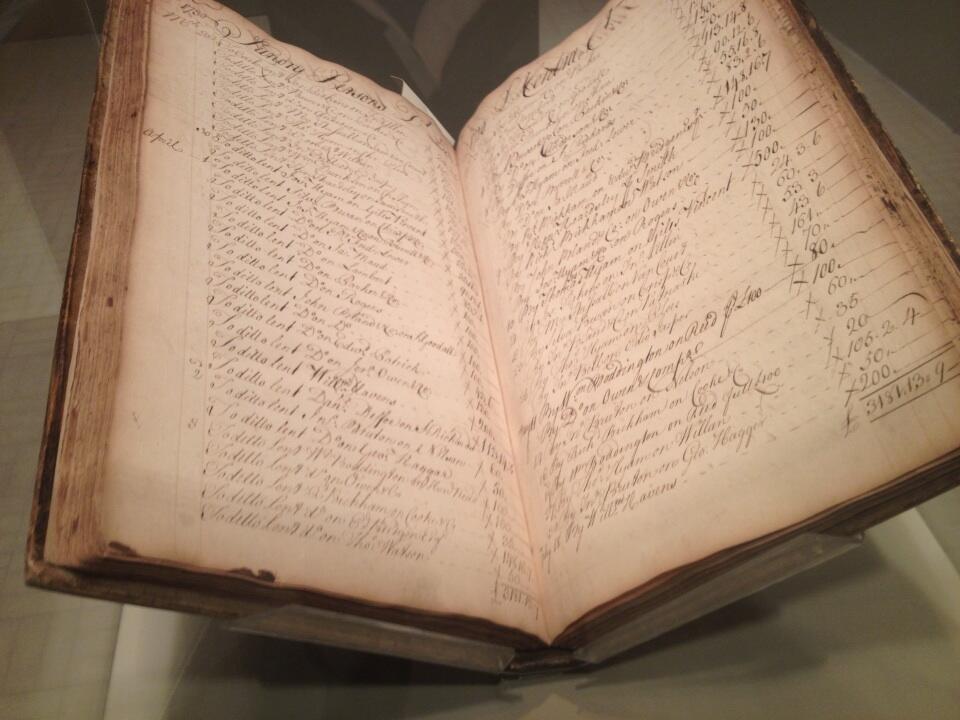
Now to the second question. Textbooks often claim that banks take deposits and then lend them out to people, but if that were entirely true then your deposits would not be sitting there waiting for you would they? How is it that you can have access to your money when it’s ostensibly being lent out to others?
This is where we get into the realm of fractional reserve banking, the process whereby commercial banks take the base money created by the central bank (technically called M0, which includes the physical cash you may carry around) and amplify (or multiply) it by extending credit greater than the initial deposits they're given, thereby creating new money that exists nowhere else except as an entry in their accounting system (technically called M1-M3). Indeed, electronic money does not exist outside of the banks’ IT systems, but it is the main form of money we use in society, claims which can be passed around, but that cannot leave the system.
Sometimes people are bewildered by the notion that ‘commercial banks create money’. It seems to make it sound like they can create it and destroy it at will. If you have money in a Barclays account though, recorded as a data entry in their IT system, they cannot just take it away from you. It might have originally been created via the process of bank lending, but once it’s released as a legal claim into society, it cannot just be destroyed, any more than an artist can suddenly make an artwork disappear once you’ve got it hanging on your wall. There is a legally-backed reality to the money once its created, and this provides a check against complete surreality of the money supply.
The fundamental nature of the claim that you now own is precisely what we’ve discussed in the earlier sections – a social claim that has value insofar as people will accept it in exchange for goods and services. This would not be any different if the government or god or your neighbour George was creating the money. The politics of fractional reserve banking sometimes get cast as questions about the fundamental nature of money, but to me they are actually questions about whether letting private banks be primary creators of that money is responsible or fair, whether it will eventually undermine faith in currency, and whether it confers on them too much political power.
Red pill

You’re in an electronic money world largely existing in the data centres of commercial banks, and held in place by collective consciousness and power. Whether you think there is anything wrong with that is really dependant on your view of reality. If you truly do believe that money is ‘supposed’ to be gold, and if you truly do believe that only gold has ‘intrinsic’ value, then you’re likely to shit yourself at the prospect of modern money. On the other hand, if you like me see money essentially as having always been a strange, somewhat irrational social contract, your mind should rather move to the political and psychological tradeoffs involved in different forms and creators of money, and the economic distribution effects of different variations on the monetary theme.
Further reading
I hope these exercises have been useful, even if you don’t agree with my conclusions. If you want to go further down the rabbit hole, here is some potential further reading.
My piece Riches Beyond Belief in Aeon Magazine was pretty popular and generated a lively discussion. It explores alternative currencies, and what they reveal about normal currency. If you want to look at how Bitcoin interacts with modern money, and the politics around that, check out my piece, Visions of a Techno-Leviathan: The Politics of the Bitcoin Blockchain, which has also been pretty well received.
For some serious reading, check out David Graeber’s Debt: The First 5000 Years. It's is on its way to becoming a monetary classic. It’s very good at obliterating classical economic myths of barter as the origin of money, and pointing out the deeply intertwined relationship between money, debt, and money-as-debt. Adam Smith is the founder of the outdated myth of barter that Graeber dismantles, but it’s worth delving into Book 1 of the Wealth of Nations to see his ambiguous treatment of gold as money, at once admitting that it’s a construct whilst trying to simultaneously claim that it actually is a bearer of intrinsic labour value. Another classical take comes from Karl Marx, who carries forward some of Adam Smith’s theories of commodity money in Capital (check out Ch.1), but who gets more sophisticated by pinpointing how the money form is locked into a network of other goods, and elevated by them, taking on a certain mystical status.
From that point monetary theories have abounded, but I'd recommend trying to read anthropologists and psychologists rather than the bland rationalistic explanations of the mainstream economics profession. Above all though, the real red pill takes the form of undertaking your own explorations of money, exploring its orthodox and unorthodox forms, and cracking the deceptive shell that society cloaks it in.
If you enjoyed this article, please consider...
I sometimes spend weeks writing these articles, and don't generally get paid to do it, so if you enjoyed please consider doing one or two of the following:- Buy me a virtual beer!
- Tweet: You can tweet it out here
- Share it on your Facebook wall here
- Email it to one friend from here
- Leave a comment!
- Submit to Reddit
- Link to the article from your own blog so your readers can see it too
Cheers!
Rabu, 16 Juli 2014
Introducing quick sell: Sell your bitcoins faster and safer
LocalBitcoins has released a faster and safer way to sell your Bitcoins: Quick sell. The new feature is especially helpful when paying bills with Bitcoin.
Quick sell is visible in your dashboard after logging in.
Quick sell goes through all matching LocalBitcoins bitcoin buy advertisements from reputable traders. It chooses the advertisement with the best exchange rate and then makes a trade request .
The bitcoin buyer pays the transaction with the payment details you provided. If you have bills you can directly give the bill payment details in the quick sell form. (This works very well with national bank transfers, but may not be available in every country yet.)
Please note that some advertisements require SMS verification and other verifications - enable them to get access to advertisements with better prices.
Quick sell is visible in your dashboard after logging in.
How quick sell works
Start by selecting payment method, currency and country (if required). Next, choose the amount you wish to sell. At this point, Quick sell shows the estimate how many Bitcoins would be needed for the transaction. Finally fill in the required details and click “Send trade request”.
Quick sell goes through all matching LocalBitcoins bitcoin buy advertisements from reputable traders. It chooses the advertisement with the best exchange rate and then makes a trade request .
The bitcoin buyer pays the transaction with the payment details you provided. If you have bills you can directly give the bill payment details in the quick sell form. (This works very well with national bank transfers, but may not be available in every country yet.)
Please note that some advertisements require SMS verification and other verifications - enable them to get access to advertisements with better prices.
 |
| Paying a 100 € phone bill. |
Jumat, 11 Juli 2014
Secure your account with login guard
Login guard is the latest account security feature on LocalBitcoins. If your LocalBitcoins account is being accessed from a web browser or a device not seen before an email confirmation is required when logging in.

Login guard is automatically enabled for all new users. The old users can enable the login guard in their profile settings. Login guard is effective protection against phishing attacks and we hope to see the reduction of successful phishing attacks targeting new users.
LocalBitcoins works actively towards making it safer to purchase and use bitcoins. During this year there has been visible increase in attack against bitcoin users in all major bitcoin services and local bitcoin wallets stored on your computer.
Below are some highlights of LocalBitcoins security progress.

The above chart shows the percentage of the LocalBitcoins users who activated two-factor authentication after the email verification. One can see there is clear progress going on and educating the new users is working. Some methods how we have achieved this are explained below.


Login guard is automatically enabled for all new users. The old users can enable the login guard in their profile settings. Login guard is effective protection against phishing attacks and we hope to see the reduction of successful phishing attacks targeting new users.
LocalBitcoins works actively towards making it safer to purchase and use bitcoins. During this year there has been visible increase in attack against bitcoin users in all major bitcoin services and local bitcoin wallets stored on your computer.
Below are some highlights of LocalBitcoins security progress.
Two-factor activation rate progress
Two-factor is one of the most effective ways to prevent account hacks. Even online games incentive players to activate two-factor for their in-game accounts.The above chart shows the percentage of the LocalBitcoins users who activated two-factor authentication after the email verification. One can see there is clear progress going on and educating the new users is working. Some methods how we have achieved this are explained below.
A security brief for new users
After the email verification every new user is presented a choice for two-factor activation. We cannot force the users to activate the two-factor authentication, but we very clearly state one should do so.Weak account security is highlighted
If the account security settings are weak this fact is highlighted to the user all the time they are logged in.Two-factor email reminders
If anybody has bitcoins in their wallet and never activated two-factor authentication a reminder email is sent.Senin, 07 Juli 2014
Thousands of websites from South Korea will embrace Bitcoin due to Galaxia Communications

After the South Korean payment gateway giant, Galaxia Communications, announced to join Bitcoin payment method, thousands of websites from South Korea will embrace Bitcoins.
Galaxia Communications is one of the top three online payment companies in South Korea. This company has more than 10,000 customers both inside and outside of South Korea. It also is the top seller for mobile gift card and coupon in South Korea. The cooperated Bitcoin payment processor is Coinplug, which provides technology support for Bitcoin transaction.
The vice president and COO of Galaxia Communications, Yongkwang Kim, said the first time he heard about Bitcoin is just last year. Now he already has his own Bitcoin wallet. Kim also stated that persuading other staff of the company to accept Bitcoin is still challenging, since there is lots of negative news about digital currency, which makes bitcoin look unreliable. Kim also emphasised that there is no big problem in technical implementation:"We have operated many other payment methods. The operation of Bitcoin payment is relatively easier."
Source: http://www.8btc.com/koreans-have-thousands-new-online-bitcoin-opportunities-thanks-galaxia
Senin, 30 Juni 2014
Culturecom, co-founded by Jay Chou, will accept Bitcoin

When Bitcoin is rejected by giant technology and Internet companies which are qualified with finance business in China, the game platform UCAN under Culturecom, co-founded by Jay Chou, one of the most famous superstar in Asia, believes that Bitcoins, as a transaction channel, will especially benefit SMEs. The CEO Cheng Peng said the zero transaction cost of Bitcoin is much more attractive than credit card.
The CEO also pointed out that if mobile game companies publish games through iTunes, they need pay one third of their revenue to iTunes as operating fee. If customers use Visa or Master card for payment, companies also need to pay 3% - 10% of their revenue as cross-border service fee. After the payment, game companies usually can only get 10% of the revenue for profits. Although there are other open publish channels like Google, the limited operation of Google in mainland China will affect sales. On the contrary, with zero cost and open environment, Bitcoin largely attracted game companies as a transaction channel.
Although supervision authorities in mainland China forbid financial institutions and giant IT companies from being involved in or using Bitcoin, Cheng Peng believes that this instead is an advantage for SMEs to explore Bitcoin transaction. When dealing with Bitcoin, since supervision authorities regard Bitcoin as commodity, UCAN will categorise Bitcoin to inventory in financial statements.
UCAN planned to launch Bitcoin payment for mobile game in July or August. The next step is to promote Bitcoin to offline products and Apps. Cheng Peng emphasised that his company will not speculate or arbitrage Bitcoin, but only use it for daily business transaction.
Langganan:
Komentar (Atom)